

Bali Dive Sites:
Menjangan Island

Aquamarine Diving - Bali Indonesia, Kuta

DESCRIPTION OF MENJANGAN ISLAND'S DIVE SITES:

Leaf Scorpion, Menjangan Island, Garden Eel Point
Leaf Scorpionfish
Taenianotus triacanthus
Although the best diving in Menjangan is said to be Apr-Nov (during the south-east monsoon), the island can be dived year-round as it offers some of the most protected diving in Bali. The clarity of the water can, at times, be amazing, and the best in Bali - Oct-Nov often has horizontal visibility of 50M+. A current of more than 1 knot is unusual.

It was in 1978 that Menjangan became Bali's first internationally-known dive location. Consequently, in older dive guidebooks, Menjangan is described as having beautiful reef flats. Unfortunately that is no longer true. Over the years a combination of dynamite fishing and (dive!) boats anchoring into the coral have taken their toll. Then, in 1997 there was a population explosion of the coral-eating Crown of Thorns starfish and, in 1998, coral bleaching as a result of El Nino.

However, these reef flats (5-15M) are now showing strong signs of recovery and will, in all likelihood, come back with much greater diversity than they had before.

Menjangan Corals, Indonesia Diving
Corals at Menjangan Island
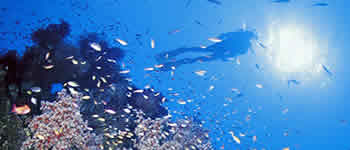
On a more positive note, Menjangan is actually famous for the wall-diving and these walls were unaffected by the above problems. They descend to varying depths, the shallowest being 26m, the deepest 60M+. The walls offer the greatest diversity of gorgonian fans in Bali. They generally start at 10m with the flat coral reefs offering gentle conditions and lots of sunlight. These are full of medium and small fish. The walls are full of small nooks and crannies, overhangs, and bigger cavelettes, crevasses, etc. They are covered with soft corals, gorgonian fans, sponges.

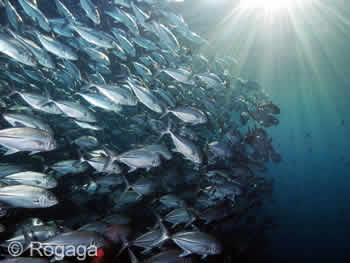
There are only rare sightings of large fish (pelagics - ocean-going fish) in Menjangan due to the island being protected from the cold currents coming in from the open sea.

The more popular dive sites at Menjangan are: The Eel Garden, Pos II and, for the more experienced, a deep dive (40M) to the Anker Wreck, a 150yr old wooden boat.


The Anker Wreck

No-one knows the name of this small wooden boat, even if it had one, or what brought it to the area. The wreck is actually named for the anchor that still lies about 6-8M from the surface. You follow the anchor chain down the steep slope to the flattened remains of the shipwreck (35-50M), which lie across about 60M of sand. This is the deepest dive site offered by AquaMarine, we believe that the good visibility and calm conditions mean that it will present no problems to experienced divers.

Following the anchor chain down to 32M, there is a second (coral-covered) anchor at the point where the site becomes a sand slope. It is here that you see the first parts of the wreck, dark against the white sand. Across the site you will find copper sheeting and bottles, the boat's cargo (artefacts, not for souvenirs). There are still some parts of the boat which remain out of the sand, and which are covered in gorgonians, a sure sign of little or no currents at the site.

The wall to the west, at 5-10M, is rich with many overhangs, cracks and caves. A good idea for an extended safety stop after this dive.


Garden Eel Point

Starting this dive from the most north-western tip of Menjangan Island, following the wall southwards towards the Bali/Menjangan channel, you will see some of the most healthy and diverse coral on Menjangan. The cracks and breaks in the wall are filled with a great diversity of reef fish.

If conditions dictate that you cannot enter at the NW tip of the island, you will enter closer to Garden Eel Point.

Longnose Hawkfish, Diving Indonesia
Longnose Hawkfish
Oxycirrhites typus
Gradually following the wall down from the top (5-8M) to 25M (max depth 35M), where it becomes a white sand slope, you find a big gorgonian fan with long-nose hawkfish. This area is also known for sightings of white tip reef shark, small schools of barracudas, turtles, and of course Napoleonfish. From this 25M point we ascend (slowly) up the slope, over many soft corals, until reaching a huge colony of garden eels, which covers the slope from 20M to beyond where it flattens out at 14M.

From Garden Eel Point we head south to a coral garden at 5-12M. This area gives us Big-Eyed Trevally, Titan Triggerfish, many clownfish in their anemones and often a surprisingly number of scorpionfish.


Pos II

Located on Menjangan's most south-easterly point, Pos II can be beach-entry or boat-entry, and is usually drift-diving: whether beach or boat, the dives start at 12M, where the white sand slope meets the top of the wall.

Emperor Angelfish, Indonesia Diving
Emperor Angelfish
Pomacantus imperator
If there is a current, it is generally north-easterly. Slowly descending along the wall, drifting with the current, to approx 25M (max depth 50M+) we see a profusion of soft corals, sponges, small gorgonians, moray eels and lionfish. Levelling out at 25M, the current takes us along the wall to the east point of the island, a dramatic area covered in large gorgonians. Here, where we meet the waters travelling down the north-east of Menjangan, there is an upwelling of cold waters from the deep ocean. This brings with it turtle, Manta Ray, shark, occasional Mola-Mola and other pelagics. We, of course, also encounter thermoclines here. Our safety stop is done above the remains of the coral reef (8-12M). As there is quite a population of Titan Triggerfish in the area, we need to choose our spot carefully.

Very occasionally we find that the current is actually heading west. Almost immediately you find an area where, if the conditions are right, you can see pelagics. Descending slowly along the wall, the diversity of reef fish is remarkable: angelfish, anthias, chromis, gobies, scorpionfish. The surface of the wall is full of crevasses, cracks and overhangs which hide many treasures. There is the occasional cave too.


Pemuteran

Located 20mins along the north coast from Labuan Lalang, Pemuteran is a small collection of resorts located on the beach. The diving here is on 500M wide coral-covered banks or mounds that go from the sand floor, at around 25M, up to about 6M from the surface. The top coral cover is a mixture of hard, soft and fire corals with some sea fans and sponges deeper. No currents to speak of and visibility is usually good, but varies quite a bit due to shallowness (wave action stirring up the bottom, run-off after rain).

The coral cover was very badly affected by coral-bleaching after El Nino in 1998.

Apr-Oct gives good conditions in Pemuteran but during the NW monsoon (Dec-Mar) conditions are usually poor (Jan and Feb is v wavy).

Due to the easy conditions, and close proximity to the resorts, you can night-dive at Pemuteran - not only on these coral mounds (takas) but also on the reef just off the beach.


MENJANGAN ISLAND HIGHLIGHTS
 
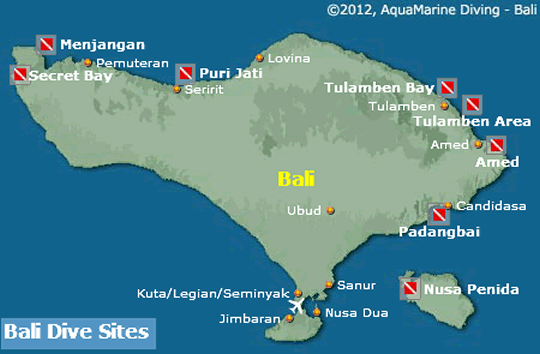
LOCATION: A small island to the north of north-west Bali, part of West Bali National Park
TYPE OF DIVE: Boat diving (one shore dive), access only by boat. Wall-diving, Drift-diving
VISIBILITY: 15 - 30 metres
CURRENT: Mild currents
DEPTHS: 5 - 40 metres
MIN LEVEL: Open Water
HIGHLIGHTS: Coral walls and grottoes.
Turtles, Barracudas, Big-eyed Trevally, Batfish.
Garden Eel Point, Anker Wreck (small C19th wooden boat)
CONDITIONS: 30-60min boat ride (dependent on site) from the small harbour of Labuan Lalang.
Beautiful vertical walls, warm water, white sand. Back-roll entry.
Menjangan, being wall-diving, has the highest rate of DCS of any Bali dive location - be a SAFE Diver (Slowly Ascend From Every dive) and do your safety stops.


close this window
go to the AquaMarine Diving Home page (different window)
go back to the previous page in this window
go forward within this window


info@AquaMarineDiving.com

Aquamarine Diving - Bali Indonesia, Kuta
Tel: +62 361 730 107
Fax: +62 361 735 368
Office Address:
Jl. Raya Seminyak 2A
Kuta, Bali
80361 Indonesia
 Mobile: (English)
+62 81 236 588 29
Correspondence Address:
PO Box 2098
Kuta - Legian, Bali
80361 Indonesia

© 2001-2002, Deborah Fugitt, City Seahorse, Inc. All rights reserved. No one, for any reason, is permitted to copy the photos, graphics or text on these pages without written permission from City Seahorse, Inc. In the event that an infringement is discovered you will be notified and invoiced the industry standard TRIPLE FEE for unauthorized usage and/or prosecuted for Copyright Infringement in U.S. Federal Court where you will be subject to pay our court costs and attorneys' fees as well as a fine of US$150,000 statutory damages. Write the webmaster for permission or information.