

Bali Dive Sites:
Nusa Penida

Aquamarine Diving - Bali Indonesia, Kuta

DESCRIPTION OF NUSA PENIDA'S DIVE SITES:

Giant Clam, Indonesia Diving
Giant Clam
Nusa Penida is the largest of 3 islands (the others being Nusa Lembongan and Nusa Ceningan). The water here is fairly cold (because of the ocean currents) but often startlingly clear, with gorgeous corals and prolific fish, with some turtle, shark (including grey reefs and silver-tips) and - Aug-Sep - Mola-Mola (the weird and wonderful Sunfish).

AquaMarine offers nine dive sites at Nusa Penida, three of which (Sental, Ped, SD) are along Nusa Penida's north coast. You could, theoretically, go in at Sental, drift along until you came to Ped, exit, change tanks, have a surface interval, re-enter the water exactly where you exited, drift along to SD, exit, out, back in at the same point - however, generally, due to conditions and changing currents, this isn't possible. There is no diving nor coral, due to conditions, along Nusa Penida's south coast.

The majority of diving at Nusa Penida is drift-diving and the currents are not always predictable. You need to listen to your guide's briefing and to follow him underwater. When diving with AquaMarine, if you do not have one of your own, you will be given an inflatable signalling device for use on the surface, in the unlikely event that you get separated from your guide/group.


Sental, Ped and SD

As mentioned above, these sites are located on the coral reef that runs the length of Nusa Penida's north coast and offers great drift-diving. This reef is richest at SD but at Ped and Sental it has suffered both as a result of coral-bleaching after El Nino in 1998 and boats anchoring into the coral. The reef has a lot of soft corals, and also many kinds of fish, such as Moorish Idols, Sweetlips, Lionfish, Moray Eel, Scorpionfish, white tip reef shark and Napoleonfish.

A Passing Manta Ray, Indonesia Diving
Manta Ray
Manta birostris
The reef (3-25M) is mainly a steep slope with flattened - by the current - barrel sponges and some stretches of deep wall (particularly between Ped and Sental). The ever-present current means that you're always going to be drift-diving, although the currents can change direction during a dive, and can become quite fast - you may end up exiting at Toyapakeh. Visibility is usually 18-30M.

Around 20-25M on this slope there is a good chance of seeing large pelagics (ocean-going fish) eg: manta ray, white tip and black tip shark, tuna, barracuda) because of the currents.

Particularly at SD, as the coral starts at 3M, it is possible - current permitting - to snorkel.


Toyapakeh

Located on the island's north-west point, in Ceningan Channel, Toyapakeh is Nusa Penida's most popular dive site. This popularity is deserved and not only because it is partially protected from the current flowing through the strait between Penida and Ceningan, but also due to the good visibility and rich coral. In addition to the coral reef, there are some very attractive coral formations, with big gorgonians, that provide excellent places to find fish and other marine life.

Toyapakeh is the location of the mooring for the big Quicksilver ship that brings day-trippers over to play on the water-chutes and banana-boats.

DFugitt_EelShrimponNose.jpg 144x215
Yellow-margined Moray with
Cleaner Shrimp on Nose
Gymnothorax flavimarginatus
Starting at 6M, this lovely reef of beautiful soft corals and thriving hard corals, gives us clouds of reef-fish including anthias, Scorpionfish, Moray Eel, trumpetfish, puffers, Giant Trevally. Starting from the area north of the Quicksilver mooring (south of the pier), at 10M you find bommies with a lot of Sweetlips. It is here that Wayan has, on several occasions, seen two sea-snakes (he's terrified of snakes both on land and underwater!). Following the slope downwards, drifting with the current, past the 10-15M area giving big schools of fish (including Jackfish and Sweetlips), Batfish, Napoleon Wrasse, and sometimes turtle; deeper on the slope (22-26M) you may have the chance to see larger pelagics including Sunfish (Mola-Mola) in Aug-Sept at 25-30M.

The current here often heads north-east, which makes for an easy and pleasant drift-dive however the current in shallow water and the current in deeper water are sometimes going in different directions, therefore the direction of your dive can change as you alter your depth. The water can be pretty cold which means thermoclines.


Gamat Bay

Located on the north-west of Nusa Penida, between Toyapakeh and Crystal Bay, Gamat Bay is one of the few dive sites at Nusa Penida where you don't have to just 'go with the flow', the bay is protected from the currents although once you head down the steep slope at the mouth, you are again drift-diving.

Nudibranch, Chromodoris Geometrica
Nudibranch
Chromodoris Geometrica
The permanent mooring allows you to descend to about 8M, the bottom being sand, coral patches and bommies. There is a profusion of colourful soft corals, with gorgonians and hard corals (including table corals) everywhere. These shallow areas are lovely, full of reef-fish - some quite rare, commensals, nudibranches, and could take your whole dive, particularly if you are a photographer (although it can be surgey). Visibility is usually superb within the bay.

The very rich 10-20M part of the slope also has some big bommies that provide some protection from the current (more of an uphill swoosh) . The larger fishlife here is fairly diverse with some large specimens of surgeonfish, grouper and unicornfish. Overhangs and a couple of small caves provide resting places for white tips and turtle (also sometimes seen in the bay itself).


Crystal Bay

Upon entering this small bay, we head for inland shelter and then descend directly down to the reef, which is 5-12M. This hard coral reef has a white sand base, and is covered with anemones and soft corals. It can be quite surgey in the bay. The marinelife includes Angelfish, Sweetlips, many Moorish Idols.

Following the north side of the bay around, we come to a Bat Cave: enter from underwater, surface inside the cave (which is open to the sky) where bats sleep overhead - big waves may crash in through the top. Sometimes 2 small reef shark are in the cave, but they leave when you arrive!

Continuing along the (very deep) wall from the Bat Cave at 20-24M, the hard corals provide homes for a lot of lobster.

Because this area is in Ceningan Channel, when there is a current present, and due to the coldness of the water from the Indian Ocean, there is definitely the opportunity to see white tip reef shark, eagle rays and also (if you're lucky) leopard shark.


Manta Point

Different dive companies chose different parts of Nusa Penida's south-west coast to call Manta Point. This area of the coastline is dramatic limestone cliffs that descend straight into the ocean. The swell can be stupendous, sometimes making entry impossible by mid-morning, AquaMarine will therefore pick you up around 06:00.

The area AquaMarine calls Manta Point rarely has a current, but sometimes has strong surge. There's a sandy bottom at 12-18m. The water is quite cold because it comes in from the ocean (22-26degrees). You may also see other pelagics such as tuna and tiger mackerel.

Please be aware that if the pelagics aren't there, there's nothing else to see except sea, sand and your buddy. This is the area where they come in to feed so while there is no guarantee you will see them, it is pretty likely. The manta are 2-4M width and totally harmless as they eat plankton.


Blue Corner

Blue Corner is located off the point of Nusa Lembongan, a long thin island just north-west of Nusa Penida and is a very popular drift dive. However the current can be strong, and can try to pull you downwards.

Soft Coral Jack Circle
Soft Corals & Trevally
Having done a back-roll off the boat, you descend to a slope starting at 10m. The slope has soft corals, puffer and boxfish. The current takes you round to the point, the corner, where there is a vertical wall, depth around 28m. Blue Corner is usually full of fish as well as shark, big Napoleon Wrasse, Eagle Rays and other marinelife. July-Sept you often see Mola-Mola (Sunfish). Please note that it is not always possible to reach the corner due to the speed and direction of the currents.


Malibu Point

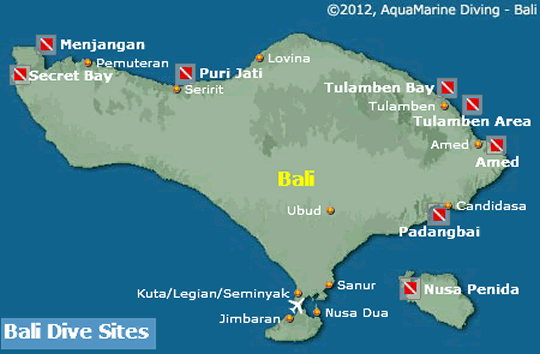
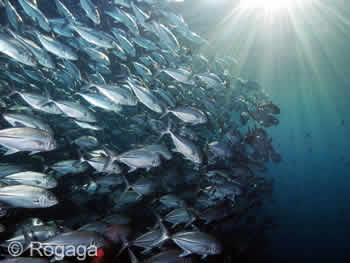
Malibu Point is on the far south-east of Nusa Penida, outside Suana village if you're interested in looking it up on a (detailed) map, about as far as you can get from the island of Bali. The reef lies on a very steep slope, the topography of which is great with table corals and big bommies going to 22M. Visibility is 20M+ but rain lowers this considerably. Huge schools of rainbow runners and Trevally are seen, as are big rays in the sand and sharks.

It has been said that Malibu Point is the best place (off Nusa Penida) to see shark, which may be true. However, the site is a long way from the mainland and is not always diveable due to the currents. The bommies provide some sanctuary from the current, which you need to have shark there, but the higher concentration of shark is to the south of the area of bommies at 15-30M.

At the northern end of the site, the currents can be very swirly, but it is a good place to see Manta and Mola-Mola (Sunfish, July-Sept)


NUSA PENIDA HIGHLIGHTS
 
LOCATION: A 17km long island, off the south-east coast of Bali
TYPE OF DIVE: Boat-diving, Drift-diving
VISIBILITY: 15 - 40 metres
CURRENT: mild to strong
DEPTHS: 6 - 40 metres
MIN LEVEL: Open Water with some experience
HIGHLIGHTS: Mola-Mola (Sunfish) in season, Eagle and Manta Rays, sharks. Many pelagics. Large schools of sweetlips, turtles.
CONDITIONS: There are dive sites all around Nusa Penida's northern coast. Very good varieties of hard and soft corals; slopes and drop-offs. The water can get pretty cold at times. Being drift-diving, it is not easy to take photographs here.


close this window
go to the AquaMarine Diving Home page (different window)
go back to the previous page in this window
go forward within this window


info@AquaMarineDiving.com

Aquamarine Diving - Bali Indonesia, Kuta
Tel: +62 361 730 107
Fax: +62 361 735 368
Office Address:
Jl. Raya Seminyak 2A
Kuta, Bali
80361 Indonesia
 Mobile: (English)
+62 81 236 588 29
Correspondence Address:
PO Box 2098
Kuta - Legian, Bali
80361 Indonesia

© 2001-2002, Deborah Fugitt, City Seahorse, Inc. All rights reserved. No one, for any reason, is permitted to copy the photos, graphics or text on these pages without written permission from City Seahorse, Inc. In the event that an infringement is discovered you will be notified and invoiced the industry standard TRIPLE FEE for unauthorized usage and/or prosecuted for Copyright Infringement in U.S. Federal Court where you will be subject to pay our court costs and attorneys' fees as well as a fine of US$150,000 statutory damages. Write the webmaster for permission or information.