

Bali Dive Sites:
Tulamben

Aquamarine Diving - Bali Indonesia, Kuta

DESCRIPTION OF TULAMBEN'S DIVE SITES:

Elegant Squat Lobster, Tulamben, Coral Garden Tulamben has become Bali's most famous diving area and therefore where you are most likely to meet internationally recognised underwater photographers and writers. Tulamben Bay, like the rest of Bali, is situated in the richest marine biogeographic zone in the world. Being on the north-east coast, the bay receives very plankton-rich waters from the major ocean current that moves from the Pacific to the Indian Ocean. This, coupled with the fact that the three main dive sites provide totally different physical environments, mean that Tulamben contains a stunningly diverse underwater ecosystem.
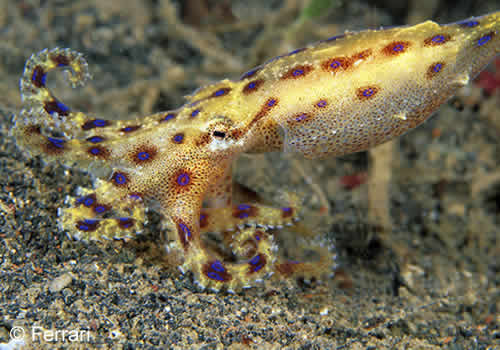
The beach is fist-sized black volcanic rocks that become sand in the shallows. This black sand does not provide the reflective properties of white limestone sand and, combined with the amount of plankton in the water, accounts for the relatively low visibility (12-25M). It does however provide a dramatic contrast, which brings out the colours of the corals, gorgonians, fish and other marinelife. The 100s of macro-species that live here both blend and contrast beautifully with the sand.

Tulamben is a wonderful place to learn to dive and to learn about underwater life. There are occasional sightings of Mola-Mola (Sunfish), Manta Rays, Whale Shark, tuna and other pelagics but it is the permanent population of Tulamben that brings people here for the 1st and 100th time.


The USAT Liberty Shipwreck

Bali's most famous dive site. Built circa WWI this cargo ship was equipped with guns for WWII, torpedoed by the Japanese off Lombok; despite attempts to tow the ship to N Bali it was taking on too much water so was semi-beached at Tulamben. Over the years anything reusable was removed. In 1963, with the earth tremors from the last eruption of Mount Agung, the wreck slid further down the slope where it still lies (as close to the beach as it can be and still be underwater!).

The Liberty lies approximately 30m offshore almost parallel to the beach on the sand slope and is suitable for all levels of qualification and experience. The wreck lies in depths from 9-30m; the shallowest part of the wreck, where it touches the sand slope, is at 5-10m. Depth along the middle of the wreck is 16-20m. The lower edge of the wreck, ie: furthest down the slope, is 20-28m (at high tide). The wreck is 120m long, it's pretty broken up (ie: no penetration possible) but you can still see the guns, toilets, boilers, anchor chain, etc. It is a lovely dive site, possibly the world's easiest wreck dive.

You can also snorkel on the wreck - the highest point of the stern is about 4m below the surface.

Visibility is usually 18-25m, lower when it has been raining. There is rarely a current present, at most it will be mild. During the 3 days before the full moon, there are usually waves. The air temp is 25-32degrees, the water 26-28degrees.

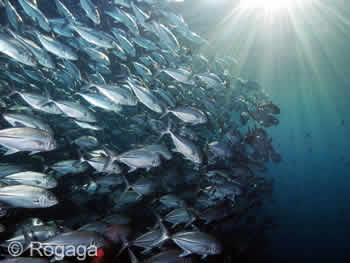
Trevally (Jacks), Liberty Wreck, Tulamben The wreck is very popular with photographers as it is totally encrusted in anemone, gorgonia and corals. The black sand provides an excellent colour contrast for the incredible variety of marinelife, which includes a huge school (literally 100s) of 10-12inch silver fish called Big-Eyed Trevally and over 400 other species of fish. All the fish are very tame (partly as a result of some guides feeding them, a rather unenvironmentally-sound practice!) from the Goatfish and Wrasse that nibble around your feet and fins during entry/exit to the Unicornfish and Surgeonfish which make a (slightly alarming the first time you see them!) beeline for your mask as you swim down towards the Wreck.

It is quite difficult to list what you will see because you'll see just about everything in any Indo-Pacific Reef Guide book if you dive here. From the minute Anglerfish, neon nudibranches, Ghost Pipefish, shrimp/goby sets, through to the areas of Garden Eels and multi-coloured clouds of anthias and damsels and on to the schools of Sweetlips, Batfish, fusiliers, Butterflyfish, the variety is amazing. Then there are the invertebrates, the hard and soft corals, black corals, sponges with crinoids, sea fans, tunicates.

If you dive early ie: first divers on the wreck (only possible if you stay overnight) you may, may, see turtle. It's the best time of day to dive the wreck.

Night diving on the wreck is great especially during the full moon. You may see Spanish Dancers, flashlight fish, phosphorescence. Where else in the world could you make such an easy - and varied - Night Dive?


The Drop-off/Wall

Masked Butterflyfish and Fan, Tulamben Drop Off / Wall
Eye-Patch Butterflyfish
Chaetodon adiergastos
This site, an old lava flow from Mount Agung, is at the opposite end of the bay from the Wreck (about 15min walk along the stony beach). The dive starts off on a steep sand slope with nudibranches, flounders, goby/shrimp sets. At 12m are sponges with many varieties of shrimp, Leaf Scorpionfish abound and there are many crinoids, often with attendant Ghost Pipefish. Continuing round to the R, the slope develops into a reef with very impressive topography, becoming a vertical wall from 15M and descending to below 60m.

Visibility - best in the morning - is usually 15-20M (due to the amount of plankton in the water) and, because of the location, it is rare that there is a current, even a mild one.

The wall has profuse sponges, corals, black coral bushes, gorgonian fans - at 30M there's one that reaches 2M in width that we visit for the Deep Dive on Advanced Courses. The wall, the lava spur, then reverts to being a steep slope.

The fish life is similar to that found on the wreck but being a much larger area, is less dense. However, more often than on the Wreck, you will see white tip reef shark, large Napoleon Wrasse, big Bumphead Parrotfish, some big Filefish (including Scrawled), and large Moray Eel. Late afternoon is the time to see the wide variety of Lionfish that live here, I'm not the person to ask why we see so many of them! There have been sightings of Whale Shark in as little as 9M of water, and much deeper, Hammerhead Shark.

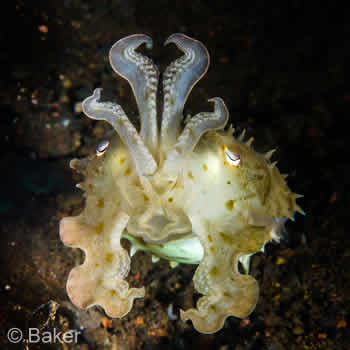
The back reef at the top of the Wall, averaging 5M, contains an excellent 'aquarium section', including cuttlefish, octopus, boxer crabs and many other unexpected treasures, enabling you to finish your dive at around 5m for pretty much as long as you want to. This is, of course, also very popular with snorkellers.


The Coral Garden

Blue Ribbon Eel, Tulamben Coral Garden
Blue Ribbon Eel
Adult Female
Rhinomuraena quaesita
Running along the middle section of Tulamben beach is a shallow reef (averaging 8-12m so also excellent for snorkelling) of mainly table and fire corals interspersed with anemones as well as barrel and other sponges. The fishlife, as with the Drop-off and the Wreck, is very diverse. It is here that you can see a surprising number of Blue Ribbon Eels (the juveniles are black) and octopus, the variety of shrimp is surprising too along with the different anemonefish. The bigger fish seen here are Bumphead Parrotfish and Black Tip reef shark.

The depth and location make the Coral Garden a very good, and popular, Night Dive on which you may see Spanish Dancers and flashlight fish.

In fact the diving actually extends much deeper than 12M, if you carry on down the sand slope, you'll find barrel sponges with many surprises: juvenile Emperor Angelfish, Two-spot Lionfish, maybe a school of juvenile catfish; cleaning stations with shrimp and wrasse, a shoal of Razorfish swaying in their hiding place. If you continue along the slope, towards the start of the Drop-off, you'll come to a dry river bed, scooped out into a bowl-shape, marked by ridges radiating outwards. These ridges are often the best places in Tulamben to find unexpected specimens. Although it is certainly not an area for divers looking for a profusion of marinelife!


Batu Kelebit (Kelebit Rocks)

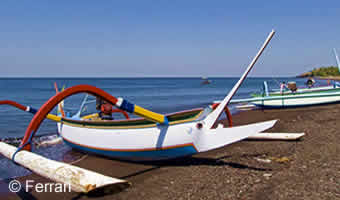
A 15 min. jukung (local outrigger) ride east from Tulamben Bay will take you to these two large rocks that lie just offshore. The dive site is quite dramatic and consists of three steep ridges encrusted with an incredible diversity of hard corals, beautiful sea fans, fire corals and sponges and between these ridges are channels of white sand.

Coleman Shrimp in Fire Urchin
Coleman Shrimp
in Fire Urchin
Periclimenes colemani
In fact, it is not only the colour of the sand that differs from Tulamben Bay, the species of even the most common reef fish are different too. The marine life varies from the tiny up to the very large: the steepness of the site combined with the structure of the ridges (and plankton-rich water) means you also have much more chance to see pelagics including barracuda, tuna, manta and white tip reef shark here than you do within the Bay.

The diving here is colder than within Tulamben Bay and not only because the diving here is generally deeper: there's a cold water eddy that comes up from the depths. Visibility is generally as low as 15-20M due to the amount of plankton in the water. The current can be quite strong at times but the channels are well-protected.


TULAMBEN HIGHLIGHTS
 
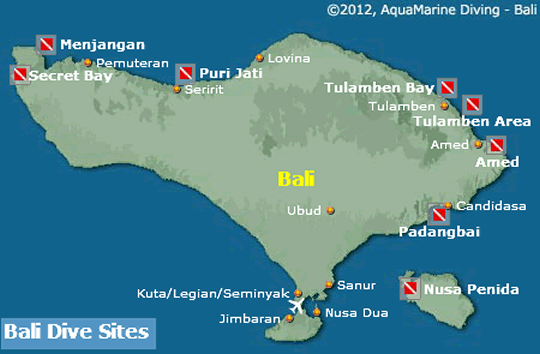
LOCATION: A small village on the north-east coast of Bali
TYPE OF DIVE: Shore Diving, Wreck-diving, Wall-diving, Night-diving, Deep-diving, photography
(Batu Kelebit is a 5min outrigger journey from Tulamben)
VISIBILITY: 12 - 25 metres
CURRENT: Zero to mild currents
DEPTHS: 3 - 40 metres (average depth 18 metres)
MIN LEVEL: Introductory - suitable for every level and interest!
HIGHLIGHTS: Extraordinary diversity of marinelife, huge school of Big-eyed Trevally. 120-metre shipwreck, beautifully coloured wall. Full Moon Night Dive. Great photographic opportunities and colour contrast with the black sand. AquaMarine's first choice for our special 1 Day Intro Adventure Diving Program. Great snorkelling site.
CONDITIONS: Black sand slope with a 120-metre shipwreck, coral gardens and a wall. The fist-sized black stones can make entry tricky when there are waves present.


close this window
go to the AquaMarine Diving Home page (different window)
go back to the previous page in this window
go forward within this window


info@AquaMarineDiving.com

Aquamarine Diving - Bali Indonesia, Kuta
Tel: +62 361 730 107
Fax: +62 361 735 368
Office Address:
Jl. Raya Seminyak 2A
Kuta, Bali
80361 Indonesia
 Mobile: (English)
+62 81 236 588 29
Correspondence Address:
PO Box 2098
Kuta - Legian, Bali
80361 Indonesia

© 2001-2002, Deborah Fugitt, City Seahorse, Inc. All rights reserved. No one, for any reason, is permitted to copy the photos, graphics or text on these pages without written permission from City Seahorse, Inc. In the event that an infringement is discovered you will be notified and invoiced the industry standard TRIPLE FEE for unauthorized usage and/or prosecuted for Copyright Infringement in U.S. Federal Court where you will be subject to pay our court costs and attorneys' fees as well as a fine of US$150,000 statutory damages. Write the webmaster for permission or information.